Showing posts with label Africa. Show all posts

Saturday, February 20, 2010

DRIIS Official album of IDRIS ELBA


“Driis”, the alter ego of actor Idris Elba and DJ Driis has finally released his awaited album titled “High Class Problem Vol 1″.

The album was recently released in England where Driis calls home and so fare it has been well received as it paints a different picture from the actor.


For those in the loop Driis first love has always been music, he started out as a DJ and an MC in East London before his career as an actor took off yet still despite his success in acting he always remained true to his first love.


Driis is the rare kind of dude who transition from acting to music without any contradiction and his “High Class Problem Volume 1″ proves just that.


This album contains different musical elements from soul, reggae, hip-hop and jazz. This album invites the listener to a whole new world of Driis, where the purity yet very mature sound keeps you on locked down wanting to listen just a lot longer. This is one of the best album released from the UK by far this year.


For more on Driis and his newest offering log onto DRIIS or Click HERE to get more info on his new CD.


Idris Elba has been one of my favorite actor and I knew him from being a DJ for a long time too, so I was happy to listen to his music and thought that he didn't sound bad at all.


Source

A ghanaian at the 2010 Winter Olympic Games

Kwame Nkrumah-Acheampong, nicknamed the Snow Leopard, is on the prowl for a gold in the 2010 Vancouver Winter Olympic games. He has drawn a lot of interest as an African skiing in the Olympics after his introduction to snow 5 years ago. The Alpine Slalom race is scheduled to take place on February 27, 2010. He will make history as the first Ghanian skiing in the Winter Olympics.

Kwame Nkrumah-Acheampong, Alpine Skiing
Height:
180 cm (5' 10")
Weight: 85 kg (187 lbs)
Date of Birth: December 19, 1974
Age: 35
Nationality: Ghana
Birthplace: Great Britain
Nickname: Snow Leopard. (ghanaweb.com, 12 Mar 2009)
Other Sports: He represented Ghana at the West African Student games in tennis. (bbc.co.uk, 28 Jul 2009)
Education: Tourism-University of Cape Coast: Cape Coast, Ghana


Quite the athlete, he also represented Ghana in the West African Student Games in tennis. Kwame took ski lessons when he got a job as a receptionist at a ski center. In an interview with BBC, he stated that , “The only thing we [Africans] have to overcome is the cold.” He credits his family and his faith in God for his success.


Dedicated to encouraging Ghanaian youth to ski, he has set up the Ghanian Winter Olympic Association and is working on building an artificial ski slope in Akuapem Hills, Mamfe, Ghana.


He supports Sabre, a British charity that builds schools in deprived areas of Ghana, and donates his spare money to a charity that is working on help save the snow leopard from extinction.
To cheer him on watch the Winter Olympics on February 27, 2010 and let us see if he brings the Africa’s first gold in this year’s Winter Olympics.


For the official website of the 2010 Winter olympics games click HERE


I wish him the best of luck.

Source

Saturday, December 5, 2009

The Real Queen of R&B: SADE ADU

I love the Album Cover


One of my favorite singer of all time is making a come back. Yes I am talking about SADE ADU, the beautiful and talented Nigerian native’s vocalist. Sade, the reclusive "quiet storm" soul singer who takes notoriously long breaks between releases is returning to the studio for the first time since recording 2000's "Lover's Rock, her long awaited sixth studio album 'Soldier of Love' is set to be released February 8th 2010, worldwide.

Sade stayed true to her surroundings during the making of ‘Soldier of Love‘ by working with her long-time band-mates in a U.K. recording studio.

Sade's 2000 release, "Lovers Rock," sold 3,881,000 copies in the U.S. and the prior album, 1992's "Love Deluxe," sold 3,407,000. Since 1985's "Diamond Life" debut, Sade has sold nearly 17 million units in the U.S. alone according to Nielsen SoundScan.

I also learned that she has a song with Maxwell on this upcoming CD. That sounds like a classic hit.

If you want to listen to her music click HERE

Ok then I guess it will be BABYBOOM Time in February 2010, Sade is timeless.

I cannot wait! This is really good news to ears that have been starving for some real music.

Thursday, November 26, 2009

Skin: The Movie


The story

This is the true story of Sandra Laing, a black girl born, through a genetic anomaly, to white Afrikaner parents in apartheid-torn South Africa.

SKIN is one of the most moving stories to emerge from apartheid South Africa: Sandra Laing is a black child born in the 1950s to white Afrikaners, unaware of their black ancestry. Her parents are rural shopkeepers serving the local black community, who lovingly bring her up as their ‘white’ little girl. But at the age of ten, Sandra is driven out of white society. The film follows Sandra’s thirty-year journey from rejection to acceptance, betrayal to reconciliation, as she struggles to define her place in a changing world - and triumphs against all odds.


Starring


Sophie Okonedo


Sam Neil


Alice Krige


Ella Ramangwane


And Tony Kgoroge


For the movie official website click HERE


To watch another version of the movie trailer click HERE


If you want to learn more about the real Sandra Laing go HERE


To buy the book titled When She Was White: The True Story of a Family Divided by Race on Amazon.com click HERE


I was able to watch the movie and let me tell you that it was such a tragic, sad, painful, enraging, and uplifting story. The Apartheid Era was a bad period and it's encouraging to think that so much time has passed.

Thursday, November 19, 2009

Jennifer Hudson: The New Winnie Mandela


Jennifer Hudson, the former American Idol contestant who won the oscar in her first screen role in "Dreamgirls" back in 2006, is ready for her next challenge.

Hudson will star in “Winnie,” a drama that casts her as the former wife of South Africa’s first black president, Nelson Mandela. Hudson will play Winnie Mandela in a film that begins production May 30 in the South African locations of Johannesburg, Cape Town, and the Transkei and Robben Island where the former President spent 18 of his 27 years in prison.

“Winnie” will be directed by Darrell J. Roodt, the veteran South African filmmaker whose 2006 film “Yesterday” was Africa’s Best Foreign Film nominee, and who also directed “Cry, The Beloved Country,” and “Sarafina!”

Andre Pieterse, Roodt and Paul L. Johnson wrote a script based on the Anne Marie du Preez Bezdrob biography "Winnie Mandela: A Life". Picture is being made with South African and Canadian money, with Pieterse producing with Michael Mosca of Canada’s Equinoxe Films.

While Nelson Mandela—who’ll be played by Morgan Freeman in the Clint Eastwood-directed “Invictus”-- is a universally sympathetic figure for his struggle against apartheid, his former wife is a far more complicated figure.


She has been depicted as the mother and wife who was a steadfast supporter of her activist husband and who was jailed herself for campaigning for his release and fighting against apartheid. Her image was subsequently tarnished by association with a bodyguard who murdered a 14-year old alleged informer, and she was later convicted of fraud.

The filmmakers will tell the whole story, good and bad.

“I was compelled and moved when I read the script,” Hudson said. “Winnie Mandela is a complex and extraordinary woman and I’m honored to be the actress asked to portray her. This is a powerful part of history that should be told.”

Hudson, who is expected to sing the film’s theme song, followed her screen debut with “The Secret Life of Bees” and “Sex in the City.” After releasing a Grammy-winning self-titled debut album earlier this year, Hudson is in the studio recording a follow-up, and then will begin preparing for the role. She also stars in “I’ll Be Home for Christmas,” an ABC holiday special to be broadcast on December 14.

Congrats Jennifer.

Saturday, November 7, 2009

Precious, the Movie: A wondrous work of art

I wanted to talk about the Movie "Precious" for some months now, and today is the perfect time since the movie will be in theaters nationwide on November 20th.


The Story

Based on the Novel 'Push' by Sapphire" - Director Lee Daniels assembles some of the unlikeliest ingredients — Lenny Kravitz, Sherri Shepherd, Mariah Carey, Mo'Nique and a lead actress Gabourey Sidibe plucked from an anonymous casting call.
Precious is the tragic and triumphant story of an obese and illiterate teenager pregnant for the second time by her rapist father and beaten down physically and mentally by her monstruous mother. When Precious gets the opportunity to attend a special high school program, a whole new world opens up.

The Cast


Gabourey "Gabby" Sidibe


My first reaction when I heard her name for the first time was "Oh she has a West African last name, she might be from Senegal or Mali" and I was not wrong because the rumor is that she was borned from a Senegalese father and an African American mother.
Gabourey Sidibe doesn't know what's coming. The star and title character of Precious, the film based on the novel Push by Sapphire, is a delightful and talented actress—and perhaps the first one to ever honestly eschew fame. "It's something I've never wanted," she says. "I didn't want to be an actress at all, or famous even. I certainly enjoy acting now, absolutely. Time will tell whether or not I enjoy fame." Whether she enjoys it or not, fame is most certainly on the horizon.

Sidibe (who goes by Gabby), delivers a raw and intensely emotional performance as Clareece "Precious" Jones, an overweight teenager who's beaten by her mother, Mary (played by Mo'Nique), and is carrying her father's baby, for a second time.
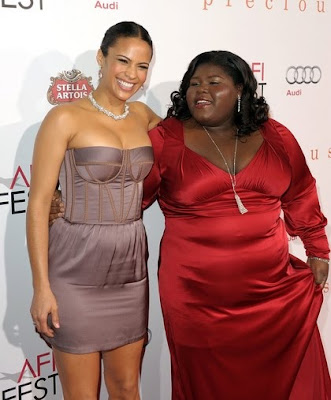
Nothing has ever gone her way, until she enrolls in an alternative school under the tutelage of Ms. Rain (Paula Patton), a kind-hearted teacher who sees potential in Precious.
Sidibe is on the best-actress short list when it comes to the 2010 Academy Awards. In October, she was the cover girl for an issue of the New York Times Magazine. She walked away with the New Hollywood statue at this year's Hollywood Awards, largely considered the kickoff to awards season.

The film, which was executive produced by Oprah Winfrey and Tyler Perry, has been surrounded by Oscar buzz since its premiere at the Toronto Film Festival, where it was the first film ever to win both the Audience Award and the Grand Jury Prize. Still, Sidibe isn't ready to call it a hit. "All the talk of awards is exciting and nerve-wracking," she says. "It feels a tad bit premature, but it certainly is something to be proud of."

Sidibe's road to Precious is one even she hasn't totally wrapped her head around. "I cut school, kind of on autopilot, to go to the audition, and within an hour of the audition, I got a call for the callback. And within half an hour of the callback, I got a call saying the director [Lee Daniels] wanted to meet with me. We met the next day, and he offered me the part," she says. "I started to cry—I guess as anyone would. I don't think I wanted the part until I had it, because it hadn't entered my mind. I didn't believe it until I was on set. I'm always looking for the other shoe to drop, so I certainly couldn't believe it until I was actually there." Perhaps more unbelievable, though, is how incredibly believable Sidibe is as the down-and-out, illiterate 16-year-old. Upon hearing her real-life high-pitched voice and friendly giggle, viewers will likely find themselves triple-checking that this seemingly happy-go-lucky, self-assured 26-year-old is in fact the woman behind the mumbling, defeated Precious Jones. Though Sidibe says she hardly sees herself in her character, she had plenty of individuals to look to for inspiration. "I knew her. She's so familiar to me. I recognize her in friends that I've had, and family members, and people I didn't want to know and people I used to be friends with," Sidibe says. "She doesn't have the greatest self-esteem, and that was certainly me at 16. But who does have a great sense of self at 16?"

Talking to Sidibe now, it's clear her sense of self is fully in tact. That she knows who she is, and that she isn't interested in celebrity or awards or success changing that, is clear. "I'm already a set person, so I can only be myself now and take each day as it comes," she says. For now, those days include the Precious press tour with her co-stars and director, the very people she says are largely responsible for her performance. "Mr. Daniels is very parental and protective of me, of all the actors, rather. That really put me at ease, because I was so scared," she says. As for her A-list co-stars like Mariah Carey, Patton, Mo'Nique and Lenny Kravitz? "They're all really awesome, talented people. Every day on set was a party." Hard to imagine on a film as disturbing as this one. "We had to be upbeat because of the subject matter," Sidibe insists. "We had to love each other so much more." Sidibe is counting on that positive energy to help deliver Precious' message of hope to the viewing public. "Precious, she gets hit by life so many different ways and so many times, but she doesn't yield to it. She continues to get up and she continues to struggle for a better life," she says.

Precious may have been Sidibe's first foray into acting, but it won't be her last. She's already wrapped up shooting her second movie, Yelling to the Sky. "In it I get to play a bad girl who drinks and fights and makes out with boys. All the things Precious would not have done," she says. She will also star in the upcoming film What Would You Do (2010 film) to be directed by Tavaris Bailey, and produced by Tyler Perry.
With just a few days until the film's release, Sidibe would have to be really out of touch not to sense the oncoming fame train, hesitant as she may be to acknowledge it. "I know that when Precious is released it may be harder for me to go to the mall and the movie theater, so I'm certainly not on the edge of my seat," she says. "I'm trying to take advantage of my life as much as possible until then." So, is she nervous? "Certainly cautious. I know a change is coming, and I don't know what that change will be," she says. "Still, I'm not about to start calling myself a celebrity." ~~Oprah.com


Mo'Nique


Paula Patton


Lenny Kravitz


Mariah Carey


Sherri Shepherd


Click HERE to view the Movie Trailer#1


Click HERE to view the Movie Trailer#2


What I've heard:


The film isn't easy to watch and will test your tolerance for despicable behavior as a long history of physical abuse and incest unfolds involving an illiterate, obese Harlem schoolgirl. Yet "Precious" — both the film and its grandly resilient title character — will steal your heart. This is a story that rises from the depths of despair to a place of genuine hope. Gabourey Sidibe offers a phenomenal screen debut as Precious, who makes an utterly believable and electrifying rise from an urban abyss of ignorance and neglect. The normally lowbrow Mo'Nique delivers an Oscar-worthy performance as Precious' viper of a mother, while great support is provided by Paula Patton, Lenny Kravitz and Mariah Carey in a small but honest role.


I haven't watch the movie myself but some people around me have and gave it a four stars out of four.


My congrats on the role of a lifetime to Gabourey Sidibe. Self-esteem is a beautiful thing and I celebrate your performance, my Senegalese Sister.


Life is hard. Life is short. Life is painful. Life is rich. Life is....Precious.


Saturday, October 24, 2009

How Not to Write About Africa, by Binyavanga Wainaina :Narrated by Djimon Hounsou

Binyavanga Wainaina


Wainaina (born 1971) is a Kenyan author, journalist and winner of the Caine Prize.

Wainaina was born in Nakuru in Rift Valley province. He attended Moi Primary School in Nakuru, Mangu High School in Thika, and Lenana School in Nairobi. He later studied commerce at the University of Transkei in South Africa, after which he worked in Cape Town for some years as a freelance food and travel writer.

In July 2002 he won the Caine Prize for African Writing for his short story ”Discovering Home”.

He is the founding editor of KWANI, the first literary magazine in East Africa since Transition Magazine. Since its founding, Kwani has since become an important source of new writing from Africa; with several writers having been nominated for, and having won, the Caine Prize subsequently.

In 2003, he was given an award by the Kenya Publisher’s Association, in recognition of his services to Kenyan Literature. He has written for The EastAfrican, National Geographic, The Sunday Times (South Africa), Granta, the New York Times and The Guardian (UK).
He is presently a Writer-in-Residence at Union College in Schenectady, NY (USA), where he is teaching, lecturing and working on a novel.

In January 2007, Binyavanga Wainaina was nominated by the World Economic Forum as a ”Young Global Leader” - an award given to people for ”their potential to contribute to shaping the future of the world.” He subsequently declined the award.

In a letter to Klaus Schwab and Queen Rania of Jordan, he wrote:
”I assume that most, like me, are tempted to go anyway because we will get to be ‘validated’ and glow with the kind of self-congratulation that can only be bestowed by very globally visible and significant people,” he wrote. “And we are also tempted to go and talk to spectacularly bright and accomplished people – our “peers.” We will achieve Global Institutional Credibility for our work, as we have been anointed by an institution that many countries and presidents bow down to.
“The problem here is that I am a writer. And although, like many, I go to sleep at night fantasizing about fame, fortune and credibility, the thing that is most valuable in my trade is to try, all the time, to keep myself loose, independent and creative…it would be an act of great fraudulence for me to accept the trite idea that I am “going to significantly impact world affairs.”
Wainaina has collected over 13,000 recipes from around Africa and is an expert on traditional and modern African cuisines.


He is also the author of “How not to write about Africa” which is a satire piece, it has become Binyavanga’s most important work and is pursued to promote the Africa that most often is not embraced. He exposes the cliches and stereotypes that non african writers employ all too often when they set out to describe the African continent.


The impact from this profound piece has even caught the attention of Benin born actor and model, Djimon Gaston Hounsou. This satire piece has awakened different opinions and some controversies along the way.


Djimon Hounsou


How Not to Write About Africa

Always use the word 'Africa' or 'Darkness' or 'Safari' in your title. Subtitles may include the words 'Zanzibar', 'Masai', 'Zulu', 'Zambezi', 'Congo', 'Nile', 'Big', 'Sky', 'Shadow', 'Drum', 'Sun' or 'Bygone'. Also useful are words such as 'Guerrillas', 'Timeless', 'Primordial' and 'Tribal'.

Note that 'People' means Africans who are not black, while 'The People' means black Africans.
Never have a picture of a well-adjusted African on the cover of your book, or in it, unless that African has won the Nobel Prize.

An AK-47, prominent ribs, naked breasts: use these. If you must include an African, make sure you get one in Masai or Zulu or Dogon dress.

In your text, treat Africa as if it were one country. It is hot and dusty with rolling grasslands and huge herds of animals and tall, thin people who are starving. Or it is hot and steamy with very short people who eat primates.

Don't get bogged down with precise descriptions. Africa is big: fifty-four countries, 900 million people who are too busy starving and dying and warring and emigrating to read your book. The continent is full of deserts, jungles, highlands, savannahs and many other things, but your reader doesn't care about all that, so keep your descriptions romantic and evocative and unparticular.
Make sure you show how Africans have music and rhythm deep in their souls, and eat things no other humans eat.

Do not mention rice and beef and wheat; monkey-brain is an African's cuisine of choice, along with goat, snake, worms and grubs and all manner of game meat. Make sure you show that you are able to eat such food without flinching, and describe how you learn to enjoy it—because you care.

Taboo subjects: ordinary domestic scenes, love between Africans (unless a death is involved), references to African writers or intellectuals, mention of school-going children who are not suffering from yaws or Ebola fever or female genital mutilation.

Throughout the book, adopt a sotto voice, in conspiracy with the reader, and a sad I-expected-so-much tone. Establish early on that your liberalism is impeccable, and mention near the beginning how much you love Africa, how you fell in love with the place and can't live without her.

Africa is the only continent you can love—take advantage of this. If you are a man, thrust yourself into her warm virgin forests. If you are a woman, treat Africa as a man who wears a bush jacket and disappears off into the sunset. Africa is to be pitied, worshipped or dominated. Whichever angle you take, be sure to leave the strong impression that without your intervention and your important book, Africa is doomed.

Your African characters may include naked warriors, loyal servants, diviners and seers, ancient wise men living in hermitic splendour. Or corrupt politicians, inept polygamous travel-guides, and prostitutes you have slept with. The Loyal Servant always behaves like a seven-year-old and needs a firm hand; he is scared of snakes, good with children, and always involving you in his complex domestic dramas.

The Ancient Wise Man always comes from a noble tribe (not the money-grubbing tribes like the Gikuyu, the Igbo or the Shona). He has rheumy eyes and is close to the Earth. The Modern African is a fat man who steals and works in the visa office, refusing to give work permits to qualified Westerners who really care about Africa. He is an enemy of development, always using his government job to make it difficult for pragmatic and good-hearted expats to set up NGOs or Legal Conservation Areas. Or he is an Oxford-educated intellectual turned serial-killing politician in a Savile Row suit. He is a cannibal who likes Cristal champagne, and his mother is a rich witch-doctor who really runs the country.

Among your characters you must always include The Starving African, who wanders the refugee camp nearly naked, and waits for the benevolence of the West. Her children have flies on their eyelids and pot bellies, and her breasts are flat and empty. She must look utterly helpless. She can have no past, no history; such diversions ruin the dramatic moment. Moans are good. She must never say anything about herself in the dialogue except to speak of her (unspeakable) suffering.

Also be sure to include a warm and motherly woman who has a rolling laugh and who is concerned for your well-being. Just call her Mama. Her children are all delinquent. These characters should buzz around your main hero, making him look good. Your hero can teach them, bathe them, feed them; he carries lots of babies and has seen Death. Your hero is you (if reportage), or a beautiful, tragic international celebrity/aristocrat who now cares for animals (if fiction).

Bad Western characters may include children of Tory cabinet ministers, Afrikaners, employees of the World Bank. When talking about exploitation by foreigners mention the Chinese and Indian traders. Blame the West for Africa's situation. But do not be too specific.
Broad brushstrokes throughout are good.

Avoid having the African characters laugh, or struggle to educate their kids, or just make do in mundane circumstances. Have them illuminate something about Europe or America in Africa. African characters should be colourful, exotic, larger than life—but empty inside, with no dialogue, no conflicts or resolutions in their stories, no depth or quirks to confuse the cause.

Describe, in detail, naked breasts (young, old, conservative, recently raped, big, small) or mutilated genitals, or enhanced genitals. Or any kind of genitals. And dead bodies. Or, better, naked dead bodies. And especially rotting naked dead bodies.

Remember, any work you submit in which people look filthy and miserable will be referred to as the 'real Africa', and you want that on your dust jacket. Do not feel queasy about this: you are trying to help them to get aid from the West.

The biggest taboo in writing about Africa is to describe or show dead or suffering white people.

Animals, on the other hand, must be treated as well rounded, complex characters. They speak (or grunt while tossing their manes proudly) and have names, ambitions and desires. They also have family values: see how lions teach their children? Elephants are caring, and are good feminists or dignified patriarchs. So are gorillas. Never, ever say anything negative about an elephant or a gorilla. Elephants may attack people's property, destroy their crops, and even kill them. Always take the side of the elephant. Big cats have public-school accents. Hyenas are fair game and have vaguely Middle Eastern accents. Any short Africans who live in the jungle or desert may be portrayed with good humour (unless they are in conflict with an elephant or chimpanzee or gorilla, in which case they are pure evil).

After celebrity activists and aid workers, conservationists are Africa's most important people. Do not offend them. You need them to invite you to their 30,000-acre game ranch or 'conservation area', and this is the only way you will get to interview the celebrity activist. Often a book cover with a heroic-looking conservationist on it works magic for sales.

Anybody white, tanned and wearing khaki who once had a pet antelope or a farm is a conservationist, one who is preserving Africa's rich heritage. When interviewing him or her, do not ask how much funding they have; do not ask how much money they make off their game.

Never ask how much they pay their employees.

Readers will be put off if you don't mention the light in Africa. And sunsets, the African sunset is a must. It is always big and red. There is always a big sky. Wide empty spaces and game are critical—Africa is the Land of Wide Empty Spaces.

When writing about the plight of flora and fauna, make sure you mention that Africa is overpopulated. When your main character is in a desert or jungle living with indigenous peoples (anybody short) it is okay to mention that Africa has been severely depopulated by Aids and War (use caps).

You'll also need a nightclub called Tropicana, where mercenaries, evil nouveau riche Africans and prostitutes and guerrillas and expats hang out.

Always end your book with Nelson Mandela saying something about rainbows or renaissances. Because you care.


To watch Djimon's video click HERE


Enjoy!!!!!!!!!!!!!!!!!!!!!

Saturday, September 26, 2009

The Beautiful Nollywood Actress Rita Dominic, one of my Fav'


The year is almost coming to an end but the blessings seem to be pouring in non stop for Rita.


Just a few months after she became one of globacoms ambassadors, there is a rumor out there saying that she has just been elected as the new face of Nokia Africa and was paid over 1 MILLION DOLLARS for a 6 month contract.


Rita will be promoting Nokia's new product which is the Nokia N97 in Africa.


There will soon be a Press Conference to announce it. Rita is really excited about this Nokia deal, the blessings are too much that's why it would be easy to count all of her teeth if you tried as she cant stop smiling''.


If this is true I am very happy for her, I guess being part of Nollywood opens all the doors.


Congratulations Rita.

Thursday, September 24, 2009

The Movie Bronx Princess: A journey to Ghana


Every now and then, some Ghanaian parents living abroad would send their notorious kids to families in Ghana for some good old Ghanaian parenting aimed at reforming them. A similar captivating tale is told of a 17-year-old teenager's journey as she leaves behind her mother in New York City to reunite with her father in the award winning documentary, ‘Bronx Princess’.
Rocky Otoo is the Bronx-bred teenage daughter of Ghanaian parents, and she's no pushover. She is a sassy high-achiever bound for college. With freedom in sight, Rocky rebels against her mother's rules. When their relationship reaches a breaking point, Rocky flees to her father, a chief in Ghana. What follows is captured in Bronx Princess, a tumultuous coming-of-age story set in a homeland both familiar and strange.

By confronting her immigrant parents' ideas of adulthood, Rocky reconciles her African heritage with her dream of independence. Her precocious — and very American — ideas of a successful, independent life conflict with her father's traditional African values. Reconciling her dual legacies becomes an unexpected chapter in this unforgettable young woman's education. Filmmakers Yoni Brook and Musa Syeed met a 17-year old Otoo in 2008, at her mother’s beauty supply shop in Mount Eden. The high school senior was set to graduate, and then visit her father in Ghana.

In an interview with Otoo, she revealed …“I hadn’t seen my dad in two years. Yoni and Musa thought it was an amazing story. They found me at school the next day and asked to shoot a documentary.”Otoo is a bright and outgoing young woman. She’d recently landed a role in the school musical and agreed to the documentary plan. “I thought it would be an amazing opportunity,” Otoo said. “It was glamorous.” Brook and Syeed trailed Otoo, cameras in hand. “It was unscripted,” she said. “I walked and talked. The cameras followed me. Eventually, I forgot that the cameras were there.”


About her journey to Ghana, she said, “I thought I was used to Ghanaian culture. I was born and raised in the Bronx but there were so many Ghanaians in my neighborhood.” She thought wrong.

The documentary was shown at the West African Arts Festival block party earlier in September and is now available on DVD


But in the meantime you can watch it online from September 23, 2009 to October 23, 2009 HERE

The Most Remote Spot on Earth

Satellite View


We live in a technologically advanced and interconnected world. Places that were once almost impossible to reach are now accessible by road systems, waterways and airplane rides. Despite the ease with which we can contact people on the other side of the globe -- whether it be through the click of a mouse or a letter in the post -- about 10 percent of the Earth is more than 48 hours away, by way of land travel, from the nearest city. While in recent years it definitely has become easier to reach far away lands, there are many places in the world that remain inaccessible, uninhabited and secluded -- in other words, the most remote spots on Earth.


To determine whether a location qualifies as "remote," you should consider the inaccessibility of the place (how difficult it is to reach the spot) and its isolation (the distance from the nearest inhabited location). In terms of inaccessibility, the point farthest from sea is the Eurasian Pole of Inaccessibility, which is located more than 1,553 miles (2,500 kilometers) from any ocean and is located in northern China. The point farthest from land is Point Nemo, which is in the South Pacific, more than 1,553 miles (2,500 kilometers) from any land mass. Neither of these locations are inhabited by humans.


What's the most remote inhabited location on Earth? A place called Tristan da Cunha. The approximately 270 residents of this archipelago see a mail ship only once a year. Tristan da Cunha is located at 37 South and 12 West, 1,242 miles (2,000 kilometers) from St. Helena and 1,739.8 miles (2,800 kilometers) from the nearest mainland, the Cape of Good Hope, South Africa. Tristan is circular in shape and is about 6.2 miles (10 kilometers) in diameter with a total area of only about 30 square miles (78 square kilometers). The summer season falls between December and March. During the winter months, the central volcanic peak of Tristan, which rises to a height of 6,594 feet (2,010 meters), is covered in snow. Tristan da Cunha, the main island, is the only inhabited island in the chain. The other islands that make up the archipelago -- Nightingale, Stoltenhof, Gough, Middle and the appropriately named Inaccessible -- are not populated by humans.


The blue arrow is where Tristan Da Cunha is located in relation to South America on the left and South Africa on the right.

There are a few land masses nearer to Tristan Da Cunha than South Ameria and Africa, although many are uninhabited.

Currently the only method of travelling to Tristan Da Cunha is via a boat from Cape Town (in South Africa) - this is one of Tristan's 'nearby' locations. Saint Helenas (north of Tristan) is also relatively nearby, as is "South Georgia and the South Sandwitch island" and "Bouvet Island" to its south.

But how did people come to inhabit this remote island chain? And how did they find out about it in the first place?


Tristan da Cunha: The World's Most Remote Inhabited Island


Today, Tristan da Cunha is certainly off the beaten path and is considered the most remote inhabited island on the planet. But in the 17th and 18th centuries, the archipelago was on the preferred maritime route to the Cape of Good Hope and the Indian Ocean. The islands of Tristan da Cunha were discovered by Portuguese explorer Tristao da Cunha during an expedition to the Cape of Good Hope in 1506. In 1643, the first recorded crew, the Dutch Heemstede, landed on Tristan to replenish supplies. In 1650 and 1669, the Dutch initiated efforts to explore the island as a base but soon abandoned the idea, perhaps because Tristan lacked a safe harbor.


Several Americans attempted to make use of Tristan in the 18th and 19th centuries. In 1790, Captain John Patten of Philadelphia used the island as a sealing and whaling base. In 1810, Jonathan Lambert of Salem, Mass., attempted to establish a trading station there. During the War of 1812, American forces used Tristan as a base to defend against British attacks.


While today's Tristan is off the international political radar, it was at the center of the strategic military scene during the early 1800s. On Aug. 14, 1816, the British military took possession of the island to prevent the French from using Tristan to rescue the deposed emperor Napoleon who was imprisoned on St. Helena, about 1,242 miles (2,000 kilometers) away. The British also aimed to keep Americans from using Tristan as a base again.


Despite this initial political interest in Tristan, the British military soon lost interest in its strategic importance and began to gradually abandon the island in 1817. With the opening of the Suez Canal in 1869, routes through the South Atlantic were no longer necessary for trans-Atlantic trade, and ships ceased to pass through Tristan. However, some of Tristan's original residents stayed on the island, and, in addition to a few shipwreck survivors, they continued to populate the island. Many of their descendants still live on this remote island in the middle of the South Atlantic.


Today, Tristan is classified as a United Kingdom Overseas Territory, and all of its residents are British citizens. The residents of Tristan da Cunha, who live in the settlement of Edinburgh, share just eight surnames. Tristan houses a school, hospital, post office, museum, cafe, pub, craft shop, village hall and swimming pool. The island is financially self-supporting, and residents earn most of their income from fishing and, oddly, the sale of postage stamps. An optician and dentist are sent from the United Kingdom once a year. While there's no airport on Tristan, cruise ships occasionally visit the island, and crawfish trawlers from Cape Town come to the island about six times per year.


Source

Friday, July 3, 2009

The I Wear African Campaign


Waw I am featured on the I wear African Campaign, check it out on the African Vibes Magazine online (Here)


So Proud and Happy!!!!!!!!!!

Saturday, June 13, 2009

ARISE Africa Fashion Week


On Saturday, 20 June 2009, the inaugural ARISE Africa Fashion Awards will bring ARISE Africa Fashion Week (June 12th – 20th) to an exciting conclusion, with one designer winning the once-in-a-lifetime chance to present at New York Fashion Week in the ARISE Africa Rising show in September.

A world-class launching pad for the continent’s most promising designers, ARISE Africa Fashion Week—presented by ARISE Magazine and produced by African Fashion International (AFI)—will present dozens of collections from across Africa, in Johannesburg.

The awards ceremony will take place at the Sandton Convention Center, Johannesburg, in the sumptuous Pavilion Room from 6 p.m. to 10 p.m.

The Sandton Convention Center

A panel of fashion insiders and experts will present awards to designers and models in several categories, including Designer of the Year, New Face of the Year and an Award for Innovation.


In addition, esteemed humanitarian, philanthropist and former First Lady of France Cécilia Attias will deliver the keynote address, “The Promise of Africa.”
Recently she founded the Cecilia Attias Foundation to support non-governmental organizations in the improvement of women’s lives globally.

Cecilia Attias Ex Mme Sarkozy


Nduka Obaigbena, ARISE founder and THISDAY GROUP Chairman, said, "The moment for Africa is upon us. At this time of global economic crisis, the people of Africa must turn disadvantage into opportunity and show the world that we are witnessing the first green shoots of the emerging African century. We have all it takes and we're going for it!"

Nduka Obaigbena, ARISE founder

Dr. Precious Moloi-Motsepe, Founder of Africa Fashion Week and the Africa Fashion Awards, said, “Our goal is to promote and recognize the best of African fashion talent on a global scale and the ARISE Africa Fashion Awards is a further step towards fulfillment of this goal.”

Dr. Precious Moloi-Motsepe, Founder of Africa Fashion Week

Nduka Obaigbena and African Fashion International Chairperson, Dr. Precious Moloi-Motsepe, will present the Lifetime Achievement Award to a surprise honoree.

Among the event’s highlights will be a command performance from international, platinum-selling recording artist R. Kelly. R. Kelly’s appearance at the ARISE Africa Fashion Awards kicks off a multi-city tour through Africa and ends in London.

R.Kelly said "I'm very excited about my first visit to Africa, I've dreamed about this for a long time and its finally here. It will be one of the highlights of not only my career but my life. I can’t wait to perform in front of my fans in Africa – who have been some of the best in the world."

R kelly

THISDAY Music and Fashion Festivals, have brought music and fashion icons as well as world and business leaders, to Lagos, Abuja, London and Washington, DC, including Bill Clinton, Jay-Z, Beyoncé, Rihanna, Usher and many more.

ARISE Africa Fashion Week launches at a unique moment in history. The U.S. First Lady Michelle Obama’s preference for young, multicultural designers, European fashion houses’ rage for African motifs and Italian Vogue’s recent best-selling issue on black style all point to an unprecedented opportunity for African designers.

The ARISE Africa Fashion Awards will train the spotlight on the source of all this inspiration, Africa, and will provide a platform from which its gifted designers can launch international careers and businesses.
ARISE Africa Fashion Week has already confirmed the participation of over 51 of the best African fashion designers from 20 countries and all regions of the continent.
ARISE Africa Fashion Week is set to become an annual event hosted by different countries on the continent each year following 2010, with Nigeria expected to host the event in 2011.

Organizers, African Fashion International, are confident that it will become one of the world’s major perennial, must-attend fashion events and I hope so too.


Here is another link to learn more about the event(clickhere).

Tuesday, May 12, 2009

Judge Hatchett discovers her African Origin


Everybody knows Judge Hatchett, she has a TV show and recently during one of the episode, she had the chance to discover where she was really from by doing a DNA test. Check it out by clicking on the following link:


Congrats to her for taking the time to make that discovery.

Monday, March 30, 2009

Jill Scott in the No. 1 LADIES Detective AGENCY


It is 3:15 AM and I just finished watching a rerun of the pilot of the new HBO serie ''The number 1 ladies detective agency'' starring Jill scott who is one of my favorite singer in the whole wide world.

Jill Scott

Anika Noni Rose
Lucian Msamati
Desmond Dube
The story
As a young girl growing up in the African nation of Botswana, Precious Ramotswe was encouraged by her father to follow her dreams, no matter what. Now in her mid-30s, Precious is doing just that — by opening her country's first and only female-owned detective agency for the benefit of those who need help the most.
The first major film/TV project to be shot entirely on location in Botswana, 'The No. 1 Ladies' Detective Agency' is based on the best-selling novels by Alexander McCall Smith and co-written and executive produced by Richard Curtis and the late Anthony Minghella. Like McCall's novels, the series chronicles the adventures of Precious Ramotswe (Jill Scott), the cheerful, eminently sensible proprietor of The No. 1 Ladies' Detective Agency, located in the Kgale Hill Shopping Center on the outskirts of Gaborone. Aided by her efficient yet high-strung secretary Grace Makutsi (Anika Noni Rose), Precious investigates a variety of cases, helping townspeople solve mysteries in their lives, from missing children to philandering husbands to con-artist scams. Precious Ramotswe exemplifies the courageous efforts by real-life Africans to improve the quality of their lives while preserving their culture. Though Precious brings a playful, even innocent, exuberance to her job, the "mysteries" she investigates are quite serious, and include child kidnapping, poverty, organized crime, health crises, spousal abandonment and infidelity — ongoing problems that confront many Africans (and Americans) today.
In the lead role of Precious Ramotswe is Jill Scott, the R&B singer/songwriter who has won three Grammy® Awards since 2005, branching out into acting with 2007's 'Hounddog' (her debut, as Big Mama Thornton) and 'Why Did I Get Married?' Other regulars include Anika Noni Rose ('Dreamgirls') as Precious' quirky secretary Grace, Lucian Msamati as her devoted suitor JLB, and Desmond Dube ('Hotel Rwanda') as her neighbor BK, a flamboyant hairdresser.
Guest stars include David Oyelowo (HBO's 'Five Days' and 'As You Like It'), Idris Elba (HBO's 'The Wire' and 'Sometimes in April') I was so happy to see him in there, he's one fine actor, Colin Salmon ('Die Another Day'), and Tony® winner John Kani ('Final Solution').

According to Precious Ramotswe, the owner of Botswana's No. 1 Ladies' Detective Agency, "There is no problem so great it cannot be solved by a cup of bush tea." Growing up in the country, Precious learned a great many things from her father: to rely on her wits, patience and memory, and most importantly, to follow her dreams, no matter what. And so, for her beloved country of Botswana, Africa and its people, Precious has started her detective career in Gaborone determined to do good with the time that God has been given her.


Alexander McCall Smith the writer of the book.


All I have to say is that I was not disappointed at all, if you have HBO you can now watch the pilot of the serie on Demand.
In the meantime here's a video link of the serie:
Never underestimate a woman's intuition.