Showing posts with label Actors. Show all posts

Saturday, February 20, 2010

DRIIS Official album of IDRIS ELBA


“Driis”, the alter ego of actor Idris Elba and DJ Driis has finally released his awaited album titled “High Class Problem Vol 1″.

The album was recently released in England where Driis calls home and so fare it has been well received as it paints a different picture from the actor.


For those in the loop Driis first love has always been music, he started out as a DJ and an MC in East London before his career as an actor took off yet still despite his success in acting he always remained true to his first love.


Driis is the rare kind of dude who transition from acting to music without any contradiction and his “High Class Problem Volume 1″ proves just that.


This album contains different musical elements from soul, reggae, hip-hop and jazz. This album invites the listener to a whole new world of Driis, where the purity yet very mature sound keeps you on locked down wanting to listen just a lot longer. This is one of the best album released from the UK by far this year.


For more on Driis and his newest offering log onto DRIIS or Click HERE to get more info on his new CD.


Idris Elba has been one of my favorite actor and I knew him from being a DJ for a long time too, so I was happy to listen to his music and thought that he didn't sound bad at all.


Source

Thursday, November 26, 2009

Skin: The Movie


The story

This is the true story of Sandra Laing, a black girl born, through a genetic anomaly, to white Afrikaner parents in apartheid-torn South Africa.

SKIN is one of the most moving stories to emerge from apartheid South Africa: Sandra Laing is a black child born in the 1950s to white Afrikaners, unaware of their black ancestry. Her parents are rural shopkeepers serving the local black community, who lovingly bring her up as their ‘white’ little girl. But at the age of ten, Sandra is driven out of white society. The film follows Sandra’s thirty-year journey from rejection to acceptance, betrayal to reconciliation, as she struggles to define her place in a changing world - and triumphs against all odds.


Starring


Sophie Okonedo


Sam Neil


Alice Krige


Ella Ramangwane


And Tony Kgoroge


For the movie official website click HERE


To watch another version of the movie trailer click HERE


If you want to learn more about the real Sandra Laing go HERE


To buy the book titled When She Was White: The True Story of a Family Divided by Race on Amazon.com click HERE


I was able to watch the movie and let me tell you that it was such a tragic, sad, painful, enraging, and uplifting story. The Apartheid Era was a bad period and it's encouraging to think that so much time has passed.

Saturday, November 7, 2009

Precious, the Movie: A wondrous work of art

I wanted to talk about the Movie "Precious" for some months now, and today is the perfect time since the movie will be in theaters nationwide on November 20th.


The Story

Based on the Novel 'Push' by Sapphire" - Director Lee Daniels assembles some of the unlikeliest ingredients — Lenny Kravitz, Sherri Shepherd, Mariah Carey, Mo'Nique and a lead actress Gabourey Sidibe plucked from an anonymous casting call.
Precious is the tragic and triumphant story of an obese and illiterate teenager pregnant for the second time by her rapist father and beaten down physically and mentally by her monstruous mother. When Precious gets the opportunity to attend a special high school program, a whole new world opens up.

The Cast


Gabourey "Gabby" Sidibe


My first reaction when I heard her name for the first time was "Oh she has a West African last name, she might be from Senegal or Mali" and I was not wrong because the rumor is that she was borned from a Senegalese father and an African American mother.
Gabourey Sidibe doesn't know what's coming. The star and title character of Precious, the film based on the novel Push by Sapphire, is a delightful and talented actress—and perhaps the first one to ever honestly eschew fame. "It's something I've never wanted," she says. "I didn't want to be an actress at all, or famous even. I certainly enjoy acting now, absolutely. Time will tell whether or not I enjoy fame." Whether she enjoys it or not, fame is most certainly on the horizon.

Sidibe (who goes by Gabby), delivers a raw and intensely emotional performance as Clareece "Precious" Jones, an overweight teenager who's beaten by her mother, Mary (played by Mo'Nique), and is carrying her father's baby, for a second time.
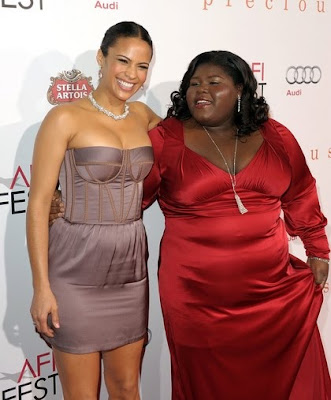
Nothing has ever gone her way, until she enrolls in an alternative school under the tutelage of Ms. Rain (Paula Patton), a kind-hearted teacher who sees potential in Precious.
Sidibe is on the best-actress short list when it comes to the 2010 Academy Awards. In October, she was the cover girl for an issue of the New York Times Magazine. She walked away with the New Hollywood statue at this year's Hollywood Awards, largely considered the kickoff to awards season.

The film, which was executive produced by Oprah Winfrey and Tyler Perry, has been surrounded by Oscar buzz since its premiere at the Toronto Film Festival, where it was the first film ever to win both the Audience Award and the Grand Jury Prize. Still, Sidibe isn't ready to call it a hit. "All the talk of awards is exciting and nerve-wracking," she says. "It feels a tad bit premature, but it certainly is something to be proud of."

Sidibe's road to Precious is one even she hasn't totally wrapped her head around. "I cut school, kind of on autopilot, to go to the audition, and within an hour of the audition, I got a call for the callback. And within half an hour of the callback, I got a call saying the director [Lee Daniels] wanted to meet with me. We met the next day, and he offered me the part," she says. "I started to cry—I guess as anyone would. I don't think I wanted the part until I had it, because it hadn't entered my mind. I didn't believe it until I was on set. I'm always looking for the other shoe to drop, so I certainly couldn't believe it until I was actually there." Perhaps more unbelievable, though, is how incredibly believable Sidibe is as the down-and-out, illiterate 16-year-old. Upon hearing her real-life high-pitched voice and friendly giggle, viewers will likely find themselves triple-checking that this seemingly happy-go-lucky, self-assured 26-year-old is in fact the woman behind the mumbling, defeated Precious Jones. Though Sidibe says she hardly sees herself in her character, she had plenty of individuals to look to for inspiration. "I knew her. She's so familiar to me. I recognize her in friends that I've had, and family members, and people I didn't want to know and people I used to be friends with," Sidibe says. "She doesn't have the greatest self-esteem, and that was certainly me at 16. But who does have a great sense of self at 16?"

Talking to Sidibe now, it's clear her sense of self is fully in tact. That she knows who she is, and that she isn't interested in celebrity or awards or success changing that, is clear. "I'm already a set person, so I can only be myself now and take each day as it comes," she says. For now, those days include the Precious press tour with her co-stars and director, the very people she says are largely responsible for her performance. "Mr. Daniels is very parental and protective of me, of all the actors, rather. That really put me at ease, because I was so scared," she says. As for her A-list co-stars like Mariah Carey, Patton, Mo'Nique and Lenny Kravitz? "They're all really awesome, talented people. Every day on set was a party." Hard to imagine on a film as disturbing as this one. "We had to be upbeat because of the subject matter," Sidibe insists. "We had to love each other so much more." Sidibe is counting on that positive energy to help deliver Precious' message of hope to the viewing public. "Precious, she gets hit by life so many different ways and so many times, but she doesn't yield to it. She continues to get up and she continues to struggle for a better life," she says.

Precious may have been Sidibe's first foray into acting, but it won't be her last. She's already wrapped up shooting her second movie, Yelling to the Sky. "In it I get to play a bad girl who drinks and fights and makes out with boys. All the things Precious would not have done," she says. She will also star in the upcoming film What Would You Do (2010 film) to be directed by Tavaris Bailey, and produced by Tyler Perry.
With just a few days until the film's release, Sidibe would have to be really out of touch not to sense the oncoming fame train, hesitant as she may be to acknowledge it. "I know that when Precious is released it may be harder for me to go to the mall and the movie theater, so I'm certainly not on the edge of my seat," she says. "I'm trying to take advantage of my life as much as possible until then." So, is she nervous? "Certainly cautious. I know a change is coming, and I don't know what that change will be," she says. "Still, I'm not about to start calling myself a celebrity." ~~Oprah.com


Mo'Nique


Paula Patton


Lenny Kravitz


Mariah Carey


Sherri Shepherd


Click HERE to view the Movie Trailer#1


Click HERE to view the Movie Trailer#2


What I've heard:


The film isn't easy to watch and will test your tolerance for despicable behavior as a long history of physical abuse and incest unfolds involving an illiterate, obese Harlem schoolgirl. Yet "Precious" — both the film and its grandly resilient title character — will steal your heart. This is a story that rises from the depths of despair to a place of genuine hope. Gabourey Sidibe offers a phenomenal screen debut as Precious, who makes an utterly believable and electrifying rise from an urban abyss of ignorance and neglect. The normally lowbrow Mo'Nique delivers an Oscar-worthy performance as Precious' viper of a mother, while great support is provided by Paula Patton, Lenny Kravitz and Mariah Carey in a small but honest role.


I haven't watch the movie myself but some people around me have and gave it a four stars out of four.


My congrats on the role of a lifetime to Gabourey Sidibe. Self-esteem is a beautiful thing and I celebrate your performance, my Senegalese Sister.


Life is hard. Life is short. Life is painful. Life is rich. Life is....Precious.


Saturday, October 24, 2009

How Not to Write About Africa, by Binyavanga Wainaina :Narrated by Djimon Hounsou

Binyavanga Wainaina


Wainaina (born 1971) is a Kenyan author, journalist and winner of the Caine Prize.

Wainaina was born in Nakuru in Rift Valley province. He attended Moi Primary School in Nakuru, Mangu High School in Thika, and Lenana School in Nairobi. He later studied commerce at the University of Transkei in South Africa, after which he worked in Cape Town for some years as a freelance food and travel writer.

In July 2002 he won the Caine Prize for African Writing for his short story ”Discovering Home”.

He is the founding editor of KWANI, the first literary magazine in East Africa since Transition Magazine. Since its founding, Kwani has since become an important source of new writing from Africa; with several writers having been nominated for, and having won, the Caine Prize subsequently.

In 2003, he was given an award by the Kenya Publisher’s Association, in recognition of his services to Kenyan Literature. He has written for The EastAfrican, National Geographic, The Sunday Times (South Africa), Granta, the New York Times and The Guardian (UK).
He is presently a Writer-in-Residence at Union College in Schenectady, NY (USA), where he is teaching, lecturing and working on a novel.

In January 2007, Binyavanga Wainaina was nominated by the World Economic Forum as a ”Young Global Leader” - an award given to people for ”their potential to contribute to shaping the future of the world.” He subsequently declined the award.

In a letter to Klaus Schwab and Queen Rania of Jordan, he wrote:
”I assume that most, like me, are tempted to go anyway because we will get to be ‘validated’ and glow with the kind of self-congratulation that can only be bestowed by very globally visible and significant people,” he wrote. “And we are also tempted to go and talk to spectacularly bright and accomplished people – our “peers.” We will achieve Global Institutional Credibility for our work, as we have been anointed by an institution that many countries and presidents bow down to.
“The problem here is that I am a writer. And although, like many, I go to sleep at night fantasizing about fame, fortune and credibility, the thing that is most valuable in my trade is to try, all the time, to keep myself loose, independent and creative…it would be an act of great fraudulence for me to accept the trite idea that I am “going to significantly impact world affairs.”
Wainaina has collected over 13,000 recipes from around Africa and is an expert on traditional and modern African cuisines.


He is also the author of “How not to write about Africa” which is a satire piece, it has become Binyavanga’s most important work and is pursued to promote the Africa that most often is not embraced. He exposes the cliches and stereotypes that non african writers employ all too often when they set out to describe the African continent.


The impact from this profound piece has even caught the attention of Benin born actor and model, Djimon Gaston Hounsou. This satire piece has awakened different opinions and some controversies along the way.


Djimon Hounsou


How Not to Write About Africa

Always use the word 'Africa' or 'Darkness' or 'Safari' in your title. Subtitles may include the words 'Zanzibar', 'Masai', 'Zulu', 'Zambezi', 'Congo', 'Nile', 'Big', 'Sky', 'Shadow', 'Drum', 'Sun' or 'Bygone'. Also useful are words such as 'Guerrillas', 'Timeless', 'Primordial' and 'Tribal'.

Note that 'People' means Africans who are not black, while 'The People' means black Africans.
Never have a picture of a well-adjusted African on the cover of your book, or in it, unless that African has won the Nobel Prize.

An AK-47, prominent ribs, naked breasts: use these. If you must include an African, make sure you get one in Masai or Zulu or Dogon dress.

In your text, treat Africa as if it were one country. It is hot and dusty with rolling grasslands and huge herds of animals and tall, thin people who are starving. Or it is hot and steamy with very short people who eat primates.

Don't get bogged down with precise descriptions. Africa is big: fifty-four countries, 900 million people who are too busy starving and dying and warring and emigrating to read your book. The continent is full of deserts, jungles, highlands, savannahs and many other things, but your reader doesn't care about all that, so keep your descriptions romantic and evocative and unparticular.
Make sure you show how Africans have music and rhythm deep in their souls, and eat things no other humans eat.

Do not mention rice and beef and wheat; monkey-brain is an African's cuisine of choice, along with goat, snake, worms and grubs and all manner of game meat. Make sure you show that you are able to eat such food without flinching, and describe how you learn to enjoy it—because you care.

Taboo subjects: ordinary domestic scenes, love between Africans (unless a death is involved), references to African writers or intellectuals, mention of school-going children who are not suffering from yaws or Ebola fever or female genital mutilation.

Throughout the book, adopt a sotto voice, in conspiracy with the reader, and a sad I-expected-so-much tone. Establish early on that your liberalism is impeccable, and mention near the beginning how much you love Africa, how you fell in love with the place and can't live without her.

Africa is the only continent you can love—take advantage of this. If you are a man, thrust yourself into her warm virgin forests. If you are a woman, treat Africa as a man who wears a bush jacket and disappears off into the sunset. Africa is to be pitied, worshipped or dominated. Whichever angle you take, be sure to leave the strong impression that without your intervention and your important book, Africa is doomed.

Your African characters may include naked warriors, loyal servants, diviners and seers, ancient wise men living in hermitic splendour. Or corrupt politicians, inept polygamous travel-guides, and prostitutes you have slept with. The Loyal Servant always behaves like a seven-year-old and needs a firm hand; he is scared of snakes, good with children, and always involving you in his complex domestic dramas.

The Ancient Wise Man always comes from a noble tribe (not the money-grubbing tribes like the Gikuyu, the Igbo or the Shona). He has rheumy eyes and is close to the Earth. The Modern African is a fat man who steals and works in the visa office, refusing to give work permits to qualified Westerners who really care about Africa. He is an enemy of development, always using his government job to make it difficult for pragmatic and good-hearted expats to set up NGOs or Legal Conservation Areas. Or he is an Oxford-educated intellectual turned serial-killing politician in a Savile Row suit. He is a cannibal who likes Cristal champagne, and his mother is a rich witch-doctor who really runs the country.

Among your characters you must always include The Starving African, who wanders the refugee camp nearly naked, and waits for the benevolence of the West. Her children have flies on their eyelids and pot bellies, and her breasts are flat and empty. She must look utterly helpless. She can have no past, no history; such diversions ruin the dramatic moment. Moans are good. She must never say anything about herself in the dialogue except to speak of her (unspeakable) suffering.

Also be sure to include a warm and motherly woman who has a rolling laugh and who is concerned for your well-being. Just call her Mama. Her children are all delinquent. These characters should buzz around your main hero, making him look good. Your hero can teach them, bathe them, feed them; he carries lots of babies and has seen Death. Your hero is you (if reportage), or a beautiful, tragic international celebrity/aristocrat who now cares for animals (if fiction).

Bad Western characters may include children of Tory cabinet ministers, Afrikaners, employees of the World Bank. When talking about exploitation by foreigners mention the Chinese and Indian traders. Blame the West for Africa's situation. But do not be too specific.
Broad brushstrokes throughout are good.

Avoid having the African characters laugh, or struggle to educate their kids, or just make do in mundane circumstances. Have them illuminate something about Europe or America in Africa. African characters should be colourful, exotic, larger than life—but empty inside, with no dialogue, no conflicts or resolutions in their stories, no depth or quirks to confuse the cause.

Describe, in detail, naked breasts (young, old, conservative, recently raped, big, small) or mutilated genitals, or enhanced genitals. Or any kind of genitals. And dead bodies. Or, better, naked dead bodies. And especially rotting naked dead bodies.

Remember, any work you submit in which people look filthy and miserable will be referred to as the 'real Africa', and you want that on your dust jacket. Do not feel queasy about this: you are trying to help them to get aid from the West.

The biggest taboo in writing about Africa is to describe or show dead or suffering white people.

Animals, on the other hand, must be treated as well rounded, complex characters. They speak (or grunt while tossing their manes proudly) and have names, ambitions and desires. They also have family values: see how lions teach their children? Elephants are caring, and are good feminists or dignified patriarchs. So are gorillas. Never, ever say anything negative about an elephant or a gorilla. Elephants may attack people's property, destroy their crops, and even kill them. Always take the side of the elephant. Big cats have public-school accents. Hyenas are fair game and have vaguely Middle Eastern accents. Any short Africans who live in the jungle or desert may be portrayed with good humour (unless they are in conflict with an elephant or chimpanzee or gorilla, in which case they are pure evil).

After celebrity activists and aid workers, conservationists are Africa's most important people. Do not offend them. You need them to invite you to their 30,000-acre game ranch or 'conservation area', and this is the only way you will get to interview the celebrity activist. Often a book cover with a heroic-looking conservationist on it works magic for sales.

Anybody white, tanned and wearing khaki who once had a pet antelope or a farm is a conservationist, one who is preserving Africa's rich heritage. When interviewing him or her, do not ask how much funding they have; do not ask how much money they make off their game.

Never ask how much they pay their employees.

Readers will be put off if you don't mention the light in Africa. And sunsets, the African sunset is a must. It is always big and red. There is always a big sky. Wide empty spaces and game are critical—Africa is the Land of Wide Empty Spaces.

When writing about the plight of flora and fauna, make sure you mention that Africa is overpopulated. When your main character is in a desert or jungle living with indigenous peoples (anybody short) it is okay to mention that Africa has been severely depopulated by Aids and War (use caps).

You'll also need a nightclub called Tropicana, where mercenaries, evil nouveau riche Africans and prostitutes and guerrillas and expats hang out.

Always end your book with Nelson Mandela saying something about rainbows or renaissances. Because you care.


To watch Djimon's video click HERE


Enjoy!!!!!!!!!!!!!!!!!!!!!

Sunday, June 7, 2009

Was it really necessary?

JIM IYKE BEATEN BLACK AND BLUE ON LOCATION IN KASTINA STATE, NIGERIA


Superstar Jim Iyke was in Kastina State on May 27th 2009 working on a project called "Day 27" .
The Boy's Cot actor signed a 3-day contract to play the lead character in the movie directed by Charles Awurum and co-produced by Chidi Chidioke and Amaka Oleka.The production quickly run into logistics problems which delayed the completion date of the shooting.

Tied up in other commitments, Jim Iyke, who had been paid upfront N 600,000 for his 3-day work, was ready to leave the project after 3 days as contracted even though he hadn't completed his part of the contract. Panic set in and the production offered Iyke extra payment to stick with the project that would have fallen apart without his participation.

The Nollywood bad boy turned a deaf ear to their supplications and also refused to refund the money he already cashed in since he hadn't completed his part. He called a taxi and loaded his luggage in, ready to leave.Amaka Olenka, who's married to a close advisor to the Kastina State governor, frantically called around, asking for help to prevent Iyke from leaving.

The taxi was about to leave the premises when security officers stormed the location and stopped the taxi. Jim Iyke was dragged out of the car and ordered to stay on the project. Tempers flared and a shouting match followed.

The security officers roughed him up and the actor tried to defend himself. The officers ganged up against the actor and beat him black and blue.

He was dragged back on the set and forced to complete his part at gunpoint.His many attempts to contact his representatives and lawyers didn't produce the effect he expected and he remained on the location till he had completed his contractual.

Wow Imagine the scandal if it was an american actor beat up the way they did Jim. This is such a sad story, I don't care about his bad attitude or whatever, this is just wrong.

Keep your head up to one of the Best Nollywood Actors.

Source: Ghananation

Monday, March 30, 2009

Jill Scott in the No. 1 LADIES Detective AGENCY


It is 3:15 AM and I just finished watching a rerun of the pilot of the new HBO serie ''The number 1 ladies detective agency'' starring Jill scott who is one of my favorite singer in the whole wide world.

Jill Scott

Anika Noni Rose
Lucian Msamati
Desmond Dube
The story
As a young girl growing up in the African nation of Botswana, Precious Ramotswe was encouraged by her father to follow her dreams, no matter what. Now in her mid-30s, Precious is doing just that — by opening her country's first and only female-owned detective agency for the benefit of those who need help the most.
The first major film/TV project to be shot entirely on location in Botswana, 'The No. 1 Ladies' Detective Agency' is based on the best-selling novels by Alexander McCall Smith and co-written and executive produced by Richard Curtis and the late Anthony Minghella. Like McCall's novels, the series chronicles the adventures of Precious Ramotswe (Jill Scott), the cheerful, eminently sensible proprietor of The No. 1 Ladies' Detective Agency, located in the Kgale Hill Shopping Center on the outskirts of Gaborone. Aided by her efficient yet high-strung secretary Grace Makutsi (Anika Noni Rose), Precious investigates a variety of cases, helping townspeople solve mysteries in their lives, from missing children to philandering husbands to con-artist scams. Precious Ramotswe exemplifies the courageous efforts by real-life Africans to improve the quality of their lives while preserving their culture. Though Precious brings a playful, even innocent, exuberance to her job, the "mysteries" she investigates are quite serious, and include child kidnapping, poverty, organized crime, health crises, spousal abandonment and infidelity — ongoing problems that confront many Africans (and Americans) today.
In the lead role of Precious Ramotswe is Jill Scott, the R&B singer/songwriter who has won three Grammy® Awards since 2005, branching out into acting with 2007's 'Hounddog' (her debut, as Big Mama Thornton) and 'Why Did I Get Married?' Other regulars include Anika Noni Rose ('Dreamgirls') as Precious' quirky secretary Grace, Lucian Msamati as her devoted suitor JLB, and Desmond Dube ('Hotel Rwanda') as her neighbor BK, a flamboyant hairdresser.
Guest stars include David Oyelowo (HBO's 'Five Days' and 'As You Like It'), Idris Elba (HBO's 'The Wire' and 'Sometimes in April') I was so happy to see him in there, he's one fine actor, Colin Salmon ('Die Another Day'), and Tony® winner John Kani ('Final Solution').

According to Precious Ramotswe, the owner of Botswana's No. 1 Ladies' Detective Agency, "There is no problem so great it cannot be solved by a cup of bush tea." Growing up in the country, Precious learned a great many things from her father: to rely on her wits, patience and memory, and most importantly, to follow her dreams, no matter what. And so, for her beloved country of Botswana, Africa and its people, Precious has started her detective career in Gaborone determined to do good with the time that God has been given her.


Alexander McCall Smith the writer of the book.


All I have to say is that I was not disappointed at all, if you have HBO you can now watch the pilot of the serie on Demand.
In the meantime here's a video link of the serie:
Never underestimate a woman's intuition.

Monday, March 9, 2009

Biggest Mistake ever

This is brad Pitt in the Troy movie and if you haven't noticed, there is a plane in the sky, and we all damn know that they were no plane during the Troy period.
This is to me a very stupid mistake...............